
Multi-Tiered Systems of Support Home
Multi-Tiered Systems of Support (MTSS)
In Gates Chili we are committed to developing a holistic approach to supporting students to maximize each student's achievement, foster belonging and support wellness in our community. New York State has adjusted its approach to supporting students academically over the last few decades, moving from a focus on Academic Intervention Services (AIS) to Response to Intervention (RtI) and most recently to Multi-Tiered System of Supports (MTSS).
What is MTSS?
-
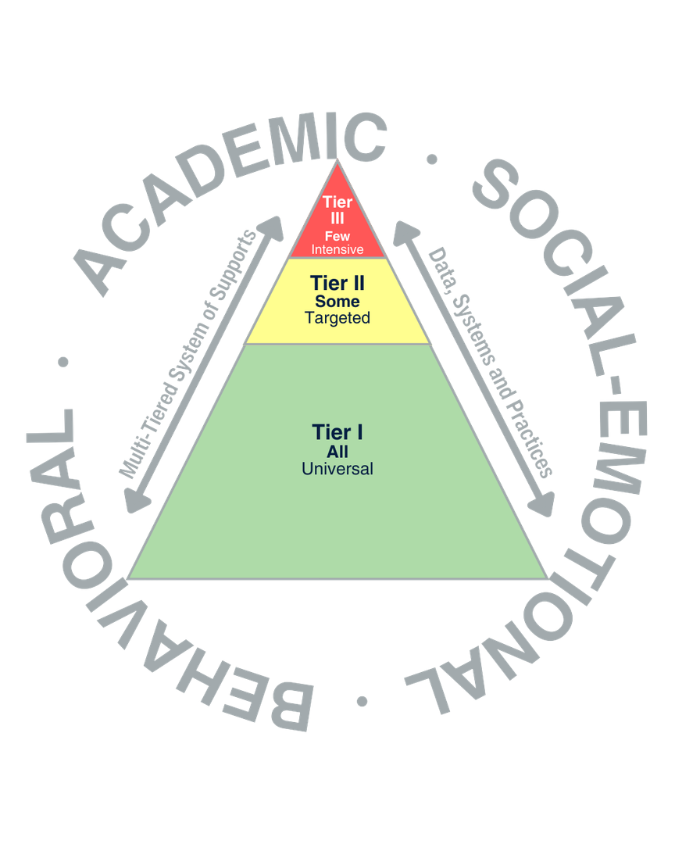
MTSS is a comprehensive framework designed to address the diverse academic, behavioral, and social-emotional needs of all students. It provides a proactive and data-driven approach to identify and support struggling students. It utilizes a three-tiered model of support that encompasses universal (Tier 1), targeted (Tier 2), and intensive (Tier 3) interventions.
Gates Chili MTSS Vision
-
Gates Chili is committed to implementing an effective Multi-Tiered System of Supports (MTSS) to equitably provide resources and ensure comprehensive supports that addresses the unique needs of each student. We are dedicated to supporting and empowering staff to implement high-quality academic, social/emotional, and behavioral instruction and intervention across all tiers, resulting in improved outcomes for each student.
Gates Chili MTSS Framework
- Universal Screening: Screen all students to accurately identify individual needs.
- Data-Based Decision-Making: Use ongoing data analysis to inform decisions regarding student needs.
- Evidence-Based: Implement evidence-based instruction, common practices, strategies and interventions.
- Tiered Interventions: Provide a multi-tiered system of supports that offers different levels of intervention based on student needs.
- Collaboration and Communication: Foster collaboration among students, educators, families, and community stakeholders to ensure a coordinated approach to support each student.
- Professional Learning: Provide ongoing learning opportunities to equip our dedicated staff with the necessary knowledge and skills to support our diverse students.
- Continuous Improvement: Regularly assess, evaluate and refine our MTSS approach to ensure its effectiveness and alignment with evolving best practices.
A Comprehensive Framework
At Gates Chili, we believe every student can succeed. Our Multi-Tiered System of Supports (MTSS) helps us make sure each student gets the right kind of help at the right time. This framework serves as a foundational resource for understanding and implementing the Multi-Tiered System of Supports (MTSS) within our district. It is designed to provide clarity on MTSS structures, define staff roles, and establish expectations for academic, attendance, behavioral, and social-emotional (SEL) supports.
MTSS is:
- A framework for supporting every student
- Integrated across academics, behavior, and SEL
- Flexible and data-informed
- Collaborative and equity-focused
MTSS isn’t:
- A single program or curriculum
- Just for students who struggle
- A permanent label, placement, or trajectory
- A one-time initiative; it is an ongoing process that evolves with our schools
- A Special Education service
We use a tiered approach to student success that brings together data, systems, and practices across all grade levels, preschool -12. This approach ensures that academic, behavioral, social-emotional, and attendance needs are addressed in a cohesive and aligned way at every tier. By using common structures, consistent progress monitoring, and collaborative problem-solving, we provide the right level of support at the right time so that all students can thrive.
-
Every child receives strong, research-based teaching and support in their classroom every day. Teachers and Student Support Services Team members use district adopted/developed curriculum, resources and strategies that help with academics, behavior, and social-emotional skills so that all students learn what they need to succeed (i.e., daily classroom instruction, social-emotional lessons, and positive behavior supports for all students).
-
Some children may need additional support in small groups to strengthen specific skills, like reading, math, or self-regulation. These supports are provided in addition to the regular classroom instruction all students receive (i.e., small group reading support or behavior skill groups for students who need extra practice).
-
A smaller number of students may need more targeted support. These services are tailored to meet each child’s unique needs and are provided more often and/or in different ways to help them make progress (i.e., targeted intervention designed with teachers and specialists).
MTSS: Connecting Past Practices to a Tiered Future
Our Multi-Tiered System of Supports (MTSS) is a flexible and evolving framework designed to help every student succeed. It builds on familiar supports like Academic Intervention Services (AIS) and Response to Intervention (RtI), bringing those practices into a more coordinated, tiered system. Through Tier 2 and Tier 3 interventions, students receive targeted support that meets their individual needs and helps us meet and exceed state expectations.
As we continue to learn and grow as a district, MTSS grows with us. Each school may approach MTSS in ways that reflect its unique community, but our shared commitment stays the same: we monitor student progress, partner with families, and use data to guide decisions that support learning. MTSS is a journey, and we will grow alongside our work to make sure every student has what they need to thrive.
Families as Partners in MTSS
At Gates Chili, we know students do their best when families and schools work together. MTSS helps us make sure every student receives the support they need to learn and grow, and families play a key role in that partnership. We value open communication so we can share updates, hear perspectives, and work together to support students.
Another important part of MTSS is consistent attendance. When students are present and engaged, it’s easier to notice strengths, identify needs, and provide timely support. We appreciate families partnering with us to build routines, troubleshooting challenges, and helping ensure students can be here each day. Showing up consistently helps build strong relationships and keeps learning moving forward.
-
A comprehensive assessment system is an organized approach to collecting and analyzing data on student learning to inform instruction and guide educational decision-making. It includes a variety of assessment types such as formative, summative, diagnostic, universal screening, and progress monitoring, each serving a specific purpose and contributing to a complete picture of student achievement and growth.
This comprehensive assessment system is purposeful and data-driven, ensuring educators have the information needed to support every student’s learning journey. By providing regular feedback, identifying areas for improvement, and guiding instructional adjustments, a comprehensive assessment system helps ensure that all students receive the support and opportunities they need to succeed. It serves not only as a tool for evaluating student performance but also as a framework for continuous improvement in teaching and learning practices.

-
Data-based decision-making is a core principle of MTSS. It ensures that instructional and intervention decisions are informed by evidence rather than assumptions. By consistently collecting, analyzing, and acting on data, educators can identify what is working, adjust supports, and respond to student needs in a timely and effective manner.
Our district uses a Data Review and Action Protocol to guide this process. This protocol:
- Promotes regular and systematic analysis of student data
- Builds shared understanding among staff while suspending judgment
- Helps teams make meaning of data and translate insights into actionable goals
- Supports collaborative planning to improve outcomes for all students
Through this structured approach, data becomes a tool for continuous improvement, helping us refine Tier 1 instruction, strengthen interventions, and ensure equitable access to high-quality learning opportunities.

-
Evidence-based instruction and interventions are central to the MTSS framework. These practices are selected based on rigorous research and demonstrated effectiveness in improving student outcomes. By implementing strategies that are grounded in evidence, educators can ensure that instructional decisions are purposeful, effective, and aligned with best practices.
-
Supports are organized to meet the varying needs of students across academic, behavioral, and social-emotional areas. This ensures that:
- All students receive strong, inclusive instruction and access to high-quality learning experiences.
- Some students benefit from additional support to reinforce or extend learning.
- A few students benefit from intensive and more individualized strategies to help them succeed.
This flexible approach ensures that every student receives the right level of support based on their unique needs.
-
Collaboration among educators and staff is essential to the success of MTSS. Clear communication, shared problem-solving, and coordinated planning help ensure that supports are aligned and responsive to student needs. Families and community partners play an important role and are engaged in ways that strengthen the overall system of support.
-
Ongoing professional learning builds staff capacity to implement MTSS effectively. Focus areas include data-informed instruction, inclusive, engaging and equitable practices, and responsive intervention strategies. These opportunities support continuous growth and ensure alignment with district goals and student needs.
-
MTSS implementation is reviewed and refined through data analysis, stakeholder feedback, and reflection on outcomes. This process ensures that practices remain effective, equitable, and responsive to evolving best practices and student needs.
Glossary
-
The process of using assessment results, classroom performance, and other student data to decide what support a student may need.
-
A tool used before instruction begins to identify students’ strengths and areas of need. It helps teachers plan targeted support and instruction from the start.
-
Adjusting instruction within the classroom to meet different student learning needs.
-
Implementing a support or intervention exactly as it was designed, to ensure it is effective.
-
A type of assessment used during learning to check student understanding and guide instruction. It helps teachers know what students need next and gives students feedback to improve. Examples include checks for understanding, exit tickets at the end of a lesson, practice questions, or observing students work and question response during class activities.
-
A specific, targeted strategy or program used to help students improve in a particular area (academic, behavior, or social-emotional).
-
A school-wide framework that provides different levels of academic, behavioral, and social-emotional support so that every student can be successful.
-
Frequent checks of a student’s performance to see if interventions are working and whether changes are needed. Examples include regular reading or math checks, reviewing work samples over time, tracking progress on specific skills, or monitoring patterns in learning or behavior from week to week.
-
Helping students develop skills such as self-awareness, self-control, teamwork, empathy, and responsible decision-making.
-
Staff such as counselors, social workers, psychologists, and interventionists who provide additional support to students.
-
An assessment given at the end of a unit, course, or period of learning to measure what students have learned. Examples include final projects, end-of-unit tests, or state exams.
-
Levels of support that increase in intensity based on student needs. All students receive Tier 1 supports; some may also need Tier 2 or Tier 3.
-
Assessments given to all students at certain times during the year to identify strengths and areas where support may be needed. Examples include schoolwide benchmarks, literacy assessments, or surveys that help understand students’ academic, social, or emotional needs.
MTSS resources for staff
Staff must be logged in to their staff account to access the links below.